
Voices from the Field - September 2026
This summer field season looks different for the Stewards of Saskatchewan due to reduced funding, but when we do get outside it’s just as enjoyable. In mid-July, Emily and I did a few day trips south of Regina to visit some potential participants, as well as to search for Loggerhead Shrikes. Grid road searches are a favourite of mine, as you get to experience the different Saskatchewan landscapes all while being on the lookout for wildlife.
Our first day was filled with plenty of bird sightings. I have never seen so many Lark Buntings in one place! We estimated we saw at least 100 within a few miles of each other, but there likely were many more – we couldn’t keep track of all of them! Although we spotted many, Lark Buntings are federally listed as Threatened. The males can be identified by their jet-black feathers with bright white patches on their outer wings, with females being more of a sandy brown. Pairs often nest close to one another in a loose “colony”, which likely explains why we were able to see so many in one area. A fun fact about Lark Buntings that I learned recently is in areas where males outnumber females, unmated males seem to serve as nest helpers, bringing food to young at the nest.
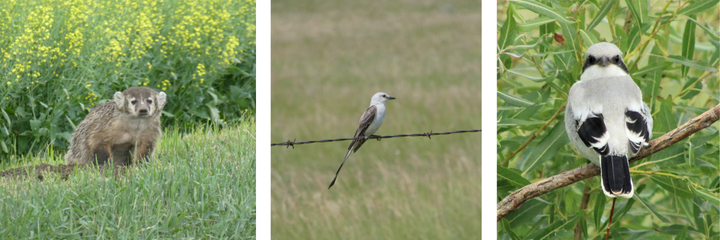
While we were on the lookout for mainly birds, the day also brought us a mammal sighting. As we were navigating the rural roads, we spotted something large running across the road. After pausing to pull out our binoculars, we realized it was a badger! We were able to pull a little closer in our vehicle and snap some pictures, which made for an exciting moment. The American Badger is federally listed as Special Concern. At present, there are no population estimates available for badgers across the prairie provinces. Because of this, we encourage people to report sightings of the American Badger in an effort to contribute to understanding how the population is doing prairie wide.
However, the highlight of the trip for me was coming across a rare bird sighting. Emily and I were keeping an eye out for Loggerhead Shrikes when she saw an intriguing looking bird sitting on barbed-wire fence. In the bright sun, this gray and salmon-pink bird was standing out; the most distinctive feature being a long, forked tail. After backing the vehicle up to where the bird was sitting, we couldn’t immediately identify what we were looking at. With limited resources with us to figure out what it was, we sent a picture of it to our coworker, Ashley, in the office to see if she could give us a hand. Ashley quickly responded and was excited to tell us that we were looking at a Scissor-tailed Flycatcher! Neither Emily nor I had heard of this bird before, and the reason is likely because they’re not typically found in Canada! Scissor-tailed Flycatchers are a rare, accidental straggler that normally breeds in south-central U.S. and just over the border into northern Mexico. During migration, some birds can wander far off course, resulting in unpredictable sightings. This was a special treat for us to see, and the sighting kept us motivated to continue with our grid road search.